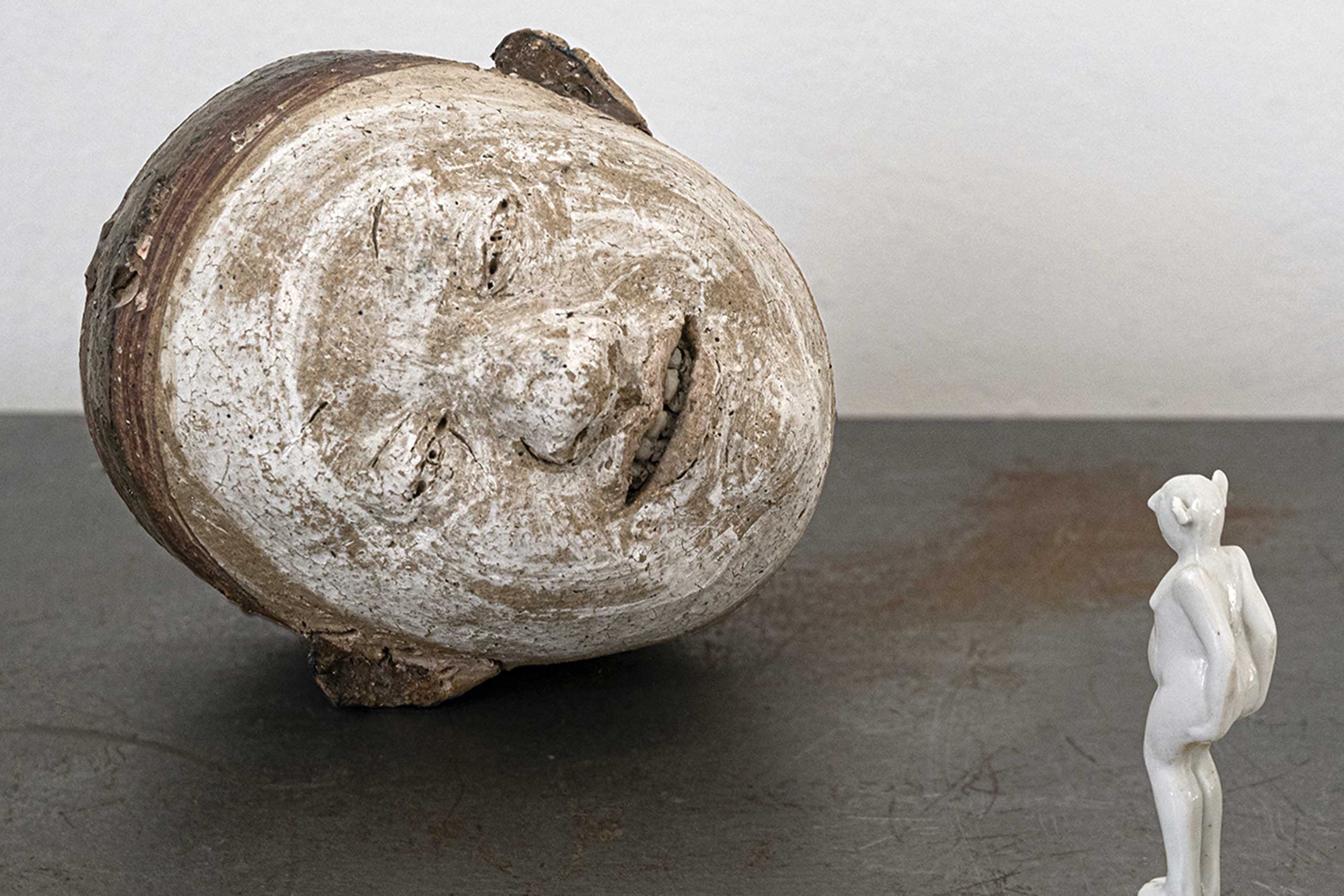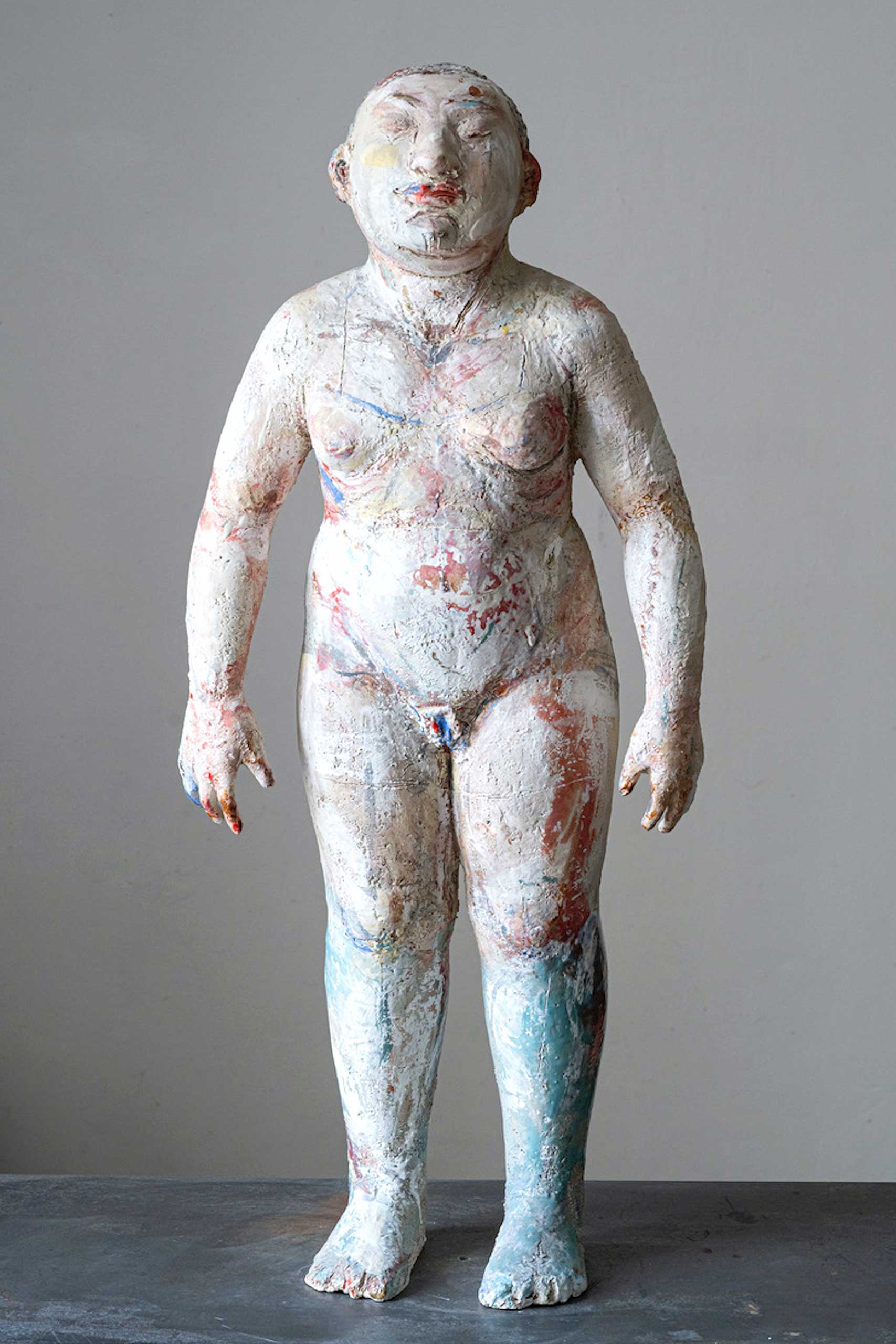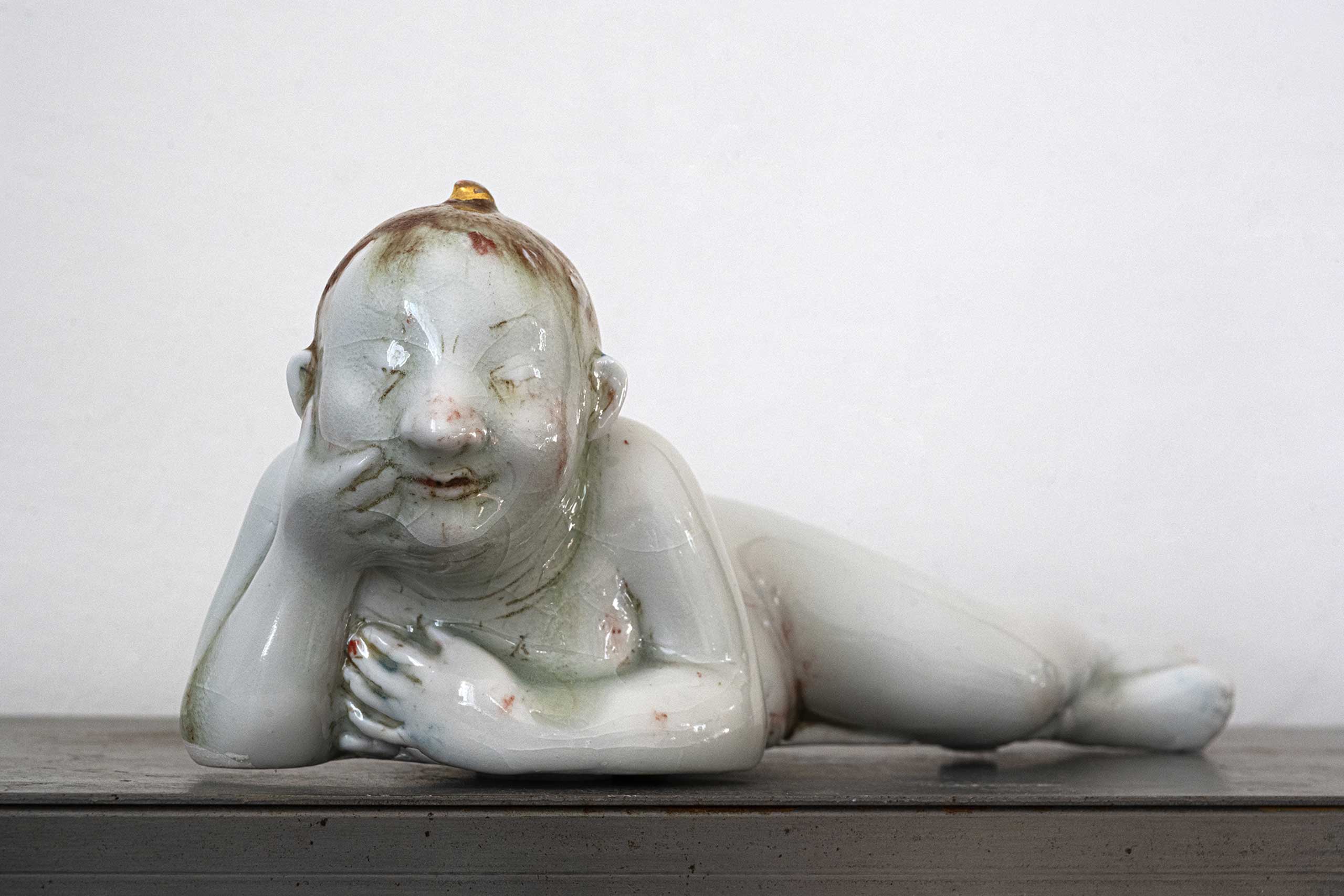
The focus of my work is the representation of figurative beings. My gaze is sharpened by images of people, movements, impressions of colors and shapes. I am searching for serene beauty and the visualization of inner states of mind. The work, which arises from irritation and breaks, is constantly evolving. The vision of a figure must be planned and carefully thought out until the final phase of the many different work processes. For me, the primary material for implementation is porcelain, in addition to clay. This white, shapelessly smooth, tenderly formless material excites and stimulates me and gives my imagination free rein. During the lengthy process of shaping and finding tension, peeling away and revealing, a kind of vacuum develops between me and my counterpart. What a pleasure it is to reach into the material and shape my thoughts! This is followed by a feverish phase of work that excludes any other activity. I have to detach myself from the precise idea and free myself from it, break it down and destroy it in order to redefine it more precisely. It is a process of constant clarification and visualization of mental presence, form, and tension. I am in harmony with my work when, after firing, it creates an irritating sense of wonder and excitement and a crossroads of opposites remains unexplored.
Gundi Dietz
Over the years, Gundi Dietz has successively reduced her art works, which evidence both a general idea as well as a personally defined authorship, to their essential form. Her creatures are always more than mere depiction and never a naturalistic representation. They show the artist’s world of experience: her knowledge and discernment, her understanding and interpretation of cultural and individual experiences. Gundi Dietz’s world is one in which space and time never entirely belong to the present moment, but are also part of the past and the future. In her work we can discern moods that are not bounded by the limits of time.
Gundi Dietz, who was born in Vienna, initially studied to become a fashion designer. She went on to complete studies in ceramic sculpture at the University of Applied Arts in Vienna in 1969, where she then spent an additional year in the master class for design theory. In 1982 she trained as a life mask sculptor in Berlin and Los Angeles. Since 1973 she has been creating her art works in a succession of different studios. The move from one studio to the next has always been indispensable for the development of her work, being closely linked to change and artistic renewal.
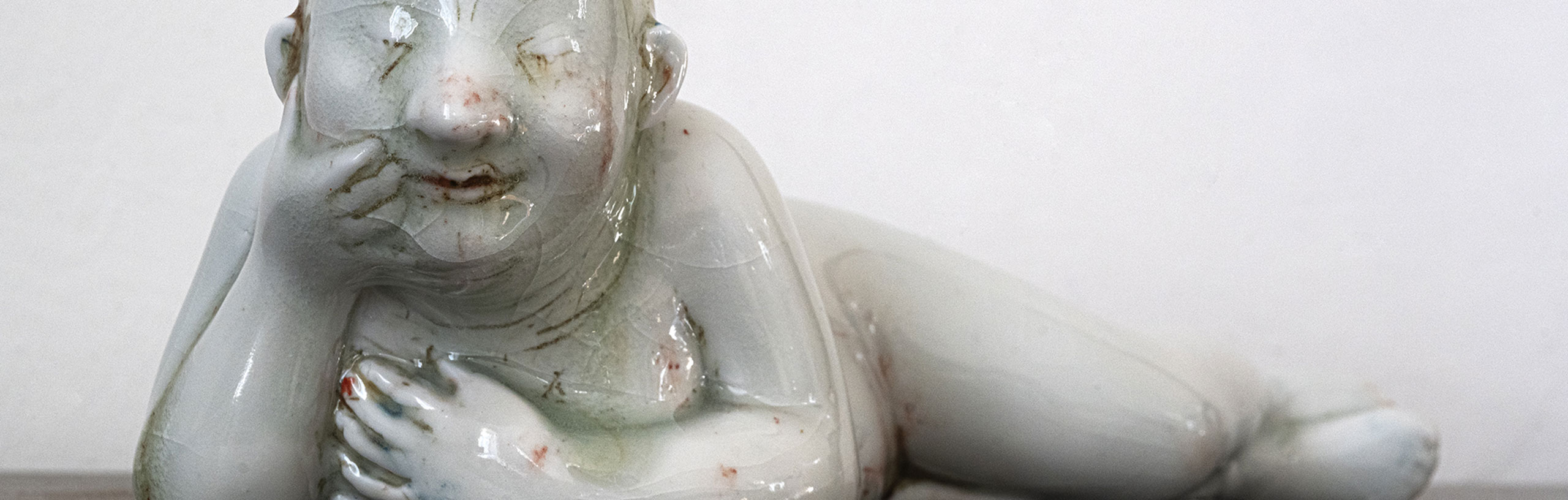
Since the beginning of her artistic practice, Gundi Dietz has not only worked with metal and stone, but mainly with porcelain, a material which has been largely marginalized in the contemporary art world. Here, she is able to manage all formats, from the tiny netsuke and her remarkable collection of iridescent beetles to sculptures in sizes technically and formally unique for free form porcelain works and large sculptures in marble, bronze, aluminum and cast cement. The exceptional quality of the brittle and extremely difficult to handle porcelain with respect to clarity, lucidity, luster, and the skin-like silkiness of the surface has made it a preferred material for the realization of her artistic ideas. The different methods available to develop forms with porcelain, the unforeseeable and the risk involved as well as the experimental and open work processes are all decisive for her, in that they pose singular artistic challenges. The handling of the raw porcelain material requires virtuosity, a great amount of concentration and an imagination refined through uncountable experiments as well as many years of experience.
Gundi Dietz’s animated figures display a constant ambivalence, which lends them a striking presence. They appear to be strong and vulnerable, introverted and extroverted, buoyant and subtle, attractive and irritating, are tangible and yet elusive. Through their bearing, their show of strength and vitality, their self-assurance and individuality one can recognize a kinship with the artist beyond her role as their creator. Each figure is unique. Form, proportion and details are as harmonious as they are inventive and evidence her exceptional mastery, both in handling the material and in the realization of artistic intentions. Gundi Dietz does not intend to create something that is merely pleasing. She does not make a clear and simple separation between beautiful and ugly, between repulsive or attractive; each creature is both, has its dignity and its wounds.
Gundi Dietz’s figures can be understood as subtle descriptions of an actual mental state, but also as a witness of a personal dream world. The artist’s subject is man’s search for spirituality and transcendence as well as the absolute loneliness of human existence. By looking either inwards or far out into the distance the figures elude direct contact with or an appropriation by the viewer, and thus retain a lasting element of secrecy. They communicate an interplay between the general image and an unsparing mirror image, between intellect and emotion, body and soul, meditative quiet and frozen movement, a sense of being lost and strength. Gundi Dietz brings out the human and the divine, the instinctive and the sublime in man. Through her great skill and her exceptional artistic sensibility she manages to combine both: the carnal and the spiritual, materiality and immateriality.
Hanspeter Dähler, Kunstforum Solothurn, Februar 2026
Translation: Ann Nelson